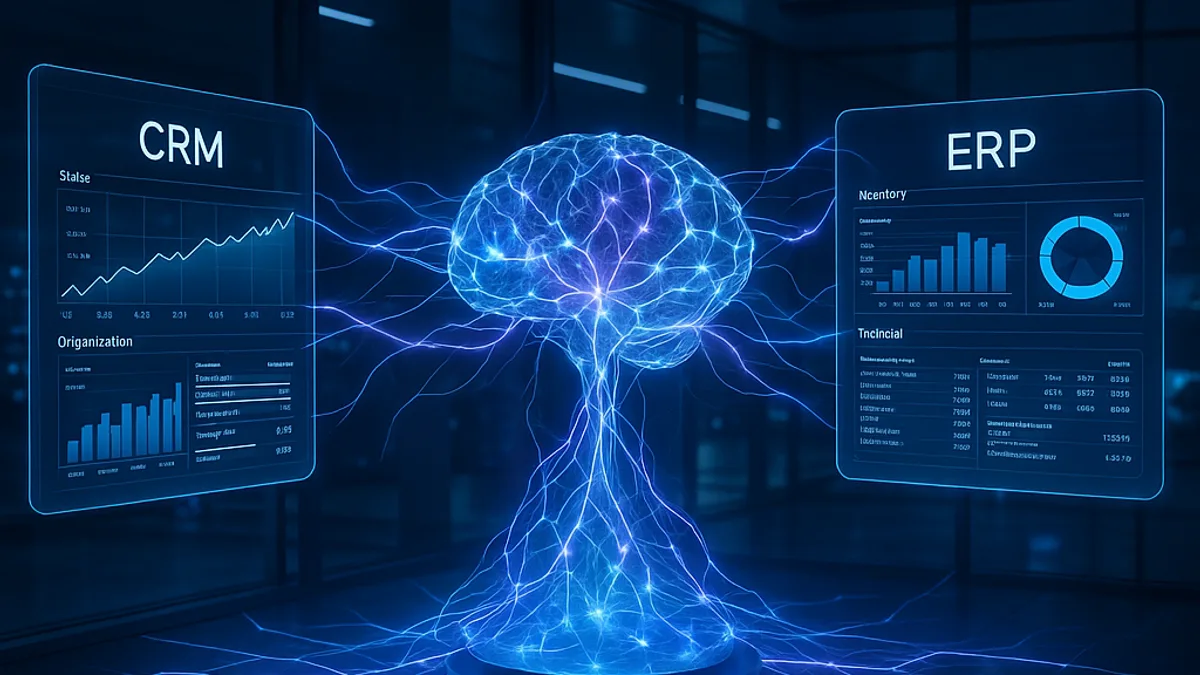
Why AI Integration with CRM and ERP Systems Is No Longer Optional
Enterprise organizations today generate more data than ever before, yet most of it remains siloed, underutilized, and disconnected from the decision-making processes that drive growth. Customer Relationship Management (CRM) and Enterprise Resource Planning (ERP) systems sit at the heart of modern business operations, managing everything from sales pipelines and customer interactions to supply chains and financial reporting. But without intelligence layered on top, these systems are little more than sophisticated databases.
AI integration with CRM and ERP systems represents a fundamental shift in how enterprises extract value from their operational data. Rather than relying on employees to manually analyze reports, identify trends, and make predictions, AI-powered CRM and ERP platforms can automate these processes in real time — delivering insights that are faster, more accurate, and more actionable than anything human analysis alone can achieve.
For business leaders evaluating digital transformation strategies, the question is no longer whether to integrate AI into core business systems, but how to do it effectively. This guide provides a comprehensive roadmap for understanding, planning, and executing AI integration for CRM and ERP systems that delivers measurable business outcomes.
Understanding AI Integration: What It Means for CRM and ERP
At its core, AI integration involves embedding machine learning models, natural language processing (NLP), predictive analytics, and intelligent automation capabilities directly into existing CRM and ERP platforms. This is not about replacing your current systems — it's about supercharging them.
AI in CRM Systems
When AI is integrated into CRM platforms like Salesforce, HubSpot, or Microsoft Dynamics 365, it transforms customer-facing operations. AI can analyze historical customer behavior to predict purchase likelihood, automate lead scoring with unprecedented accuracy, generate personalized outreach recommendations, and detect churn risk before it materializes. Sales teams spend less time on administrative tasks and more time closing deals that AI has identified as high-probability opportunities.
AI in ERP Systems
On the ERP side — platforms like SAP S/4HANA, Oracle Cloud ERP, or NetSuite — AI integration enhances operational efficiency across finance, supply chain, manufacturing, and human resources. Predictive demand forecasting reduces inventory waste. Intelligent process automation eliminates manual data entry across departments. Anomaly detection flags financial irregularities before they become costly problems. The result is an ERP system that doesn't just record what happened, but actively guides what should happen next.
The Convergence Opportunity
The most powerful outcomes emerge when AI integration spans both CRM and ERP systems simultaneously, creating a unified intelligence layer. When your sales forecasts in CRM automatically inform production planning in ERP, and when supply chain constraints in ERP trigger proactive customer communications through CRM, you achieve a level of operational coherence that creates genuine competitive advantage.
Key Benefits of AI-Powered CRM and ERP Integration
Organizations that successfully implement AI integration across CRM and ERP systems consistently report transformative benefits across multiple dimensions of their business:
- Enhanced Revenue Forecasting: AI models analyze historical sales data, market conditions, seasonal patterns, and pipeline health to generate revenue forecasts that are 20-35% more accurate than traditional methods, enabling better resource allocation and strategic planning.
- Intelligent Customer Segmentation: Machine learning algorithms identify micro-segments within your customer base that human analysts would miss, enabling hyper-personalized marketing campaigns and account management strategies that dramatically improve conversion rates.
- Automated Workflow Optimization: AI identifies bottlenecks and inefficiencies in cross-departmental workflows, automatically routing tasks, escalating exceptions, and suggesting process improvements that reduce cycle times by 30-50%.
- Predictive Maintenance and Supply Chain Resilience: AI-enhanced ERP systems anticipate equipment failures, supplier disruptions, and demand fluctuations weeks or months in advance, enabling proactive responses that minimize downtime and protect margins.
- Reduced Operational Costs: By automating repetitive tasks across both CRM and ERP environments — from invoice processing and order management to lead qualification and customer service triage — organizations typically achieve 25-40% cost reductions in targeted operational areas.
- Data-Driven Decision Making at Scale: AI transforms raw operational data into contextual, actionable intelligence delivered to the right stakeholder at the right time, eliminating the lag between data collection and strategic action.
Practical Implementation Steps for AI Integration
Successful AI integration with CRM and ERP systems requires a structured approach that balances ambition with pragmatism. Here is a proven implementation framework:
- Conduct a Comprehensive Data Audit: Before any AI implementation, assess the quality, completeness, and accessibility of data across your CRM and ERP systems. AI models are only as good as the data they consume. Identify gaps, inconsistencies, and silos that need to be addressed before integration begins.
- Define High-Impact Use Cases: Rather than attempting a broad AI rollout, identify three to five specific use cases where AI integration will deliver the most measurable business value. Prioritize based on a combination of potential ROI, data readiness, and organizational alignment.
- Select the Right AI Architecture: Determine whether native AI capabilities within your existing CRM/ERP platforms meet your needs, or whether third-party AI solutions, custom models, or a hybrid approach is required. Consider factors like scalability, vendor lock-in, and integration complexity.
- Establish a Cross-Functional Integration Team: AI integration touches sales, marketing, operations, finance, and IT. Assemble a team with representatives from each affected department, led by a project sponsor with executive authority and budget control.
- Build a Robust Data Pipeline: Create reliable, real-time data flows between your CRM, ERP, and AI processing layers. This often requires middleware, API development, and data transformation logic that ensures AI models receive clean, consistent, and timely inputs.
- Implement in Iterative Phases: Deploy AI capabilities incrementally, starting with a pilot use case in a controlled environment. Validate results against baseline metrics, gather user feedback, refine models, and then expand to additional use cases and departments.
- Invest in Change Management and Training: Technology implementation without user adoption is wasted investment. Develop comprehensive training programs that help employees understand how AI-enhanced systems change their workflows and how to leverage new capabilities effectively.
- Establish Ongoing Model Governance: AI models degrade over time as business conditions change. Implement monitoring frameworks that track model accuracy, detect drift, and trigger retraining cycles to ensure sustained performance.
Real-World Use Cases: AI Integration in Action
Understanding how leading organizations leverage AI integration across CRM and ERP systems provides valuable context for planning your own implementation:
Manufacturing: Predictive Demand and Inventory Optimization
A mid-market industrial manufacturer integrated AI across its Salesforce CRM and SAP ERP environment to create a closed-loop demand forecasting system. AI models analyzed CRM pipeline data, historical order patterns, economic indicators, and seasonal trends to generate weekly demand forecasts. These forecasts automatically triggered production scheduling adjustments and raw material procurement orders in SAP. The result: a 28% reduction in excess inventory, a 15% improvement in on-time delivery, and $4.2 million in annual carrying cost savings.
Financial Services: Intelligent Customer Lifecycle Management
A regional financial services firm embedded AI into its Microsoft Dynamics 365 CRM and ERP suite to create an intelligent customer lifecycle management system. AI models scored every customer interaction, predicted product cross-sell opportunities, identified churn risk signals, and automatically generated personalized retention offers. Customer lifetime value increased by 22%, while the cost of customer acquisition decreased by 18% within the first year of deployment.
Healthcare Distribution: Supply Chain Resilience
A healthcare distribution company integrated AI into its Oracle Cloud ERP and CRM systems to build a resilient, demand-responsive supply chain. During periods of volatile demand, AI models dynamically adjusted inventory allocation across regional warehouses based on real-time CRM data from hospital and clinic customers. Stockout incidents decreased by 41%, and the company maintained 99.2% order fulfillment rates during peak demand periods.
Key Metrics and KPIs to Track Success
Measuring the impact of AI integration in CRM and ERP systems requires a balanced scorecard of metrics that capture both operational efficiency and strategic value:
- Forecast Accuracy Improvement: Compare AI-generated sales and demand forecasts against actual outcomes, benchmarked against pre-AI forecast accuracy. Target a minimum 15-25% improvement within the first two quarters.
- Customer Lifetime Value (CLV): Track changes in average CLV as AI-driven personalization, cross-selling, and retention strategies take effect across your CRM-managed customer base.
- Process Cycle Time Reduction: Measure the time required to complete key cross-functional processes — order-to-cash, procure-to-pay, lead-to-close — before and after AI integration.
- Cost Per Transaction: Monitor the fully loaded cost of processing transactions across CRM and ERP workflows, tracking reductions attributable to AI-driven automation.
- User Adoption Rate: Track the percentage of employees actively using AI-enhanced features within CRM and ERP systems. Low adoption signals change management gaps that must be addressed to realize full ROI.
- Model Performance Metrics: Monitor AI-specific indicators like prediction accuracy, precision, recall, and F1 scores to ensure models maintain their effectiveness over time.
- Revenue Attribution: Quantify incremental revenue directly attributable to AI-driven insights, such as deals closed from AI-recommended leads or revenue protected through AI-identified churn prevention.
Getting Started: Your Next Steps Toward AI-Integrated Operations
The path to successful AI integration with CRM and ERP systems begins with clarity of purpose and a commitment to execution. Here's how to move forward:
First, assess your current state honestly. Evaluate the maturity of your existing CRM and ERP implementations, the quality of your data assets, and your organization's readiness for AI-driven change. Many integration failures stem not from technology limitations but from underestimating organizational and data readiness challenges.
Second, start with a high-value pilot. Choose a single, well-defined use case — such as AI-powered lead scoring in your CRM or predictive demand forecasting in your ERP — that can demonstrate tangible results within 90 days. Early wins build organizational momentum and executive confidence.
Third, partner with experienced AI integration specialists. The intersection of AI, CRM, and ERP requires deep expertise across multiple domains. Working with a consulting partner who understands both the technical architecture and the business strategy ensures faster time-to-value and reduces implementation risk.
At Divine Solutions, we specialize in helping enterprises design and execute AI integration strategies for CRM and ERP systems that deliver measurable business outcomes. From initial assessment and use case identification through architecture design, implementation, and ongoing optimization, our team brings the cross-functional expertise needed to transform your operational systems into intelligent, adaptive platforms.
The enterprises that thrive in the coming decade will be those that turn their CRM and ERP systems from passive record-keepers into active, AI-powered decision engines. The technology is ready. The business case is proven. The only question is how quickly you choose to act.