
AI for Retail & E-Commerce Operations
Retail and e-commerce teams benefit from practical AI systems that improve throughput, reporting, and customer experience across daily operations. Rather than adding disconnected tools, the focus is on building reliable workflows that support better decisions, faster execution, and more consistent customer interactions. From demand forecasting and replenishment planning to personalization, conversion optimization, and automated support, AI can help teams reduce manual effort while increasing accuracy and speed where it matters most.
For modern retail organizations, operational complexity grows quickly. Teams must manage changing demand, stock availability, promotions, margins, fulfillment constraints, customer expectations, and campaign performance at the same time. AI workflow automation helps connect these moving parts into a system that supports planning and execution. This creates a more responsive business model where merchandising, marketing, customer service, and operations can work from better signals instead of fragmented reports and delayed updates.
The result is not vague innovation, but practical business value. AI integration for business process automation helps retail teams improve inventory decisions, identify demand shifts earlier, personalize more effectively, and resolve customer issues with less friction. These improvements can lead to stronger conversion rates, lower stockouts, reduced excess inventory, shorter response times, and better visibility into performance at both the strategic and day-to-day levels.
Core AI Deliverables for Retail & E-Commerce Teams
Demand Forecasting and Replenishment Planning
Demand forecasting and replenishment planning help retail teams move beyond static spreadsheets and reactive ordering. AI models can evaluate historical sales, seasonality, promotional lift, product velocity, returns trends, pricing changes, and external demand signals to produce more realistic forecasts. These forecasts can then support replenishment decisions by location, channel, category, or SKU.
For retailers managing multiple sales channels, forecasting accuracy is essential to maintaining service levels without overcommitting working capital. AI can help identify where inventory should be prioritized, when replenishment thresholds should change, and which products are likely to become overstocked or understocked. This improves planning discipline while giving teams a faster way to respond to unusual demand patterns.
- Reduce stockouts on high-demand products
- Lower excess inventory and markdown risk
- Improve purchasing and replenishment timing
- Support more accurate planning around promotions and seasonality
- Increase visibility into product and category-level demand shifts
Personalization and Conversion Optimization via AI Workflow Automation
Personalized offers and conversion optimization allow e-commerce brands to deliver more relevant experiences at scale. AI can segment audiences based on behavior, purchase history, browsing patterns, cart activity, product affinity, and engagement signals. These insights can power personalized product recommendations, dynamic content, promotional logic, and triggered messaging across web, email, SMS, and paid media workflows.
Instead of relying on broad assumptions, teams can use AI to tailor offers and experiences to real customer intent. This is especially useful for increasing average order value, recovering abandoned carts, improving repeat purchase rates, and reducing friction in the buying journey. AI-enhanced workflows also make testing more efficient by helping teams identify which messages, offers, bundles, or product placements are likely to perform best for different customer segments.
- Deliver more relevant product recommendations
- Improve conversion rates with behavior-based personalization
- Increase average order value through smarter upsell and cross-sell logic
- Support lifecycle marketing with automated audience triggers
- Reduce manual campaign setup through integrated workflow automation
AI Workflow Automation for Customer Support and Ticket Deflection
AI customer support and request sorting helps retail and e-commerce teams manage service demand without sacrificing customer experience. Common inquiries around order status, return policies, shipping delays, product details, exchanges, and account issues can be handled through intelligent self-service flows, AI assistants, and automated routing.
By deflecting repetitive tickets and surfacing the right information earlier, support teams can focus on higher-value customer interactions. AI can also summarize cases, classify intent, recommend responses, and route conversations to the correct team based on urgency, order value, or issue type. This shortens handling time and improves consistency, especially during peak periods such as holiday promotions, product launches, and major sales events.
- Reduce inbound support volume through self-service automation
- Improve first-response and resolution times
- Route customer issues more accurately
- Create more consistent answers across support channels
- Free agents to handle complex or high-priority cases
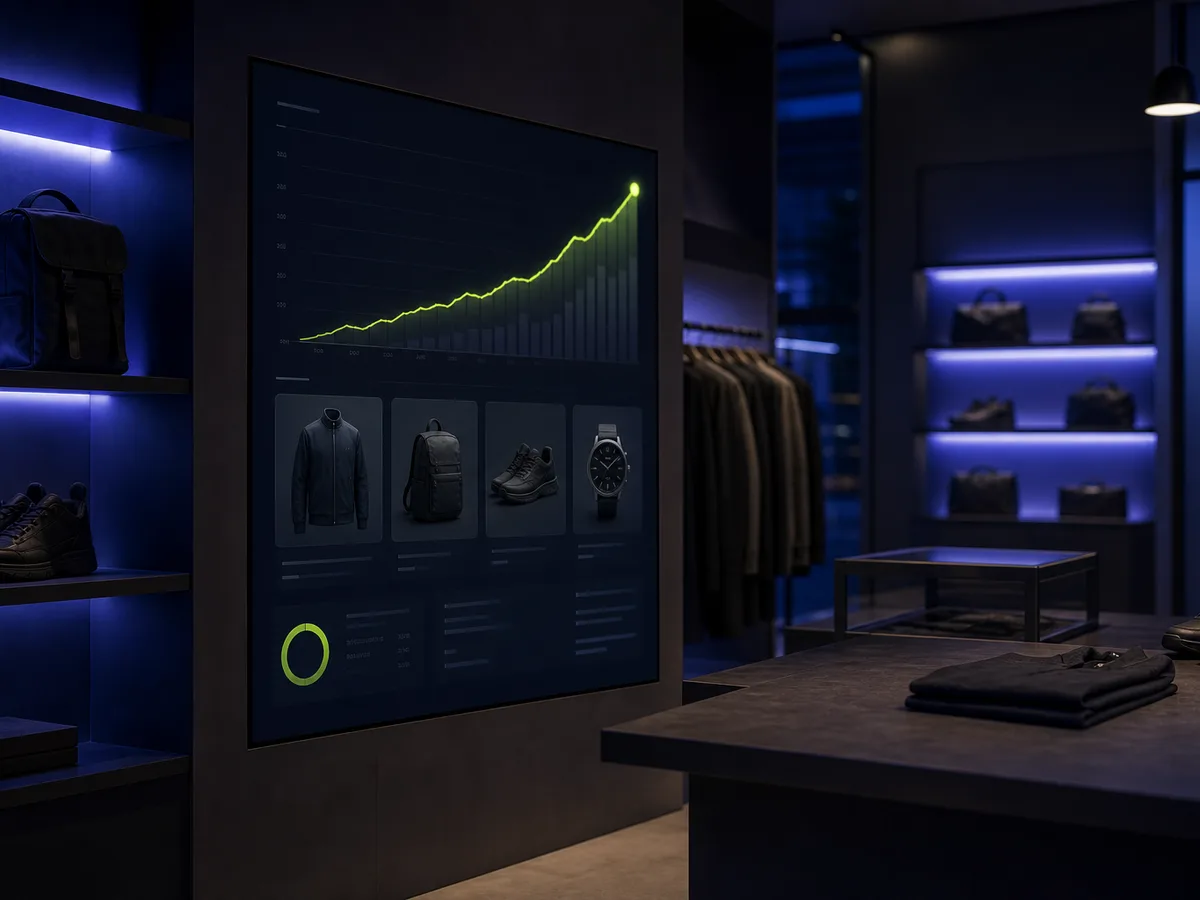
Operational Dashboards for Margin, Stock, and Campaign Performance
Operational dashboards for margin, stock and campaign performance give teams a clearer view of what is happening across the business. Instead of switching between ecommerce platforms, ERP systems, ad accounts, inventory tools, and support software, leaders can access consolidated reporting that highlights the metrics most tied to performance and profitability.
AI-supported dashboards can do more than display data. They can flag anomalies, identify trends, surface low-margin products, highlight stock exposure, and connect campaign performance to downstream outcomes such as sell-through, returns, and contribution margin. This helps teams move from descriptive reporting to action-oriented decision support.
- Track margin by product, campaign, or channel
- Monitor stock risk and replenishment priorities
- Measure campaign impact beyond top-line revenue
- Identify underperforming products or segments faster
- Support better decisions with more timely, unified reporting
Practical Benefits Across the Retail Value Chain
AI adoption in retail is most effective when it is applied to specific operational bottlenecks and measurable business goals. For merchandising teams, this may mean improving allocation and reducing inventory imbalance. For e-commerce managers, it may involve raising conversion rates and automating merchandising decisions. For support leaders, the priority may be reducing ticket volume while improving response quality. In each case, the value comes from embedding AI into the workflows teams already use.
Common use cases include forecasting demand ahead of seasonal peaks, adjusting replenishment recommendations based on campaign calendars, personalizing onsite experiences for returning visitors, automating cart recovery sequences, and reducing support tickets tied to shipping or return inquiries. Retailers can also use AI automation for e-commerce to improve promotional planning, detect margin leakage, identify slow-moving inventory earlier, and provide leadership with cleaner, more actionable reporting.
Because retail performance is highly measurable, improvements can often be tracked clearly. Teams typically look at metrics such as forecast accuracy, fill rate, stockout rate, inventory turnover, gross margin, conversion rate, average order value, cart abandonment rate, support deflection rate, response time, and campaign return on ad spend. When implemented well, AI workflow automation creates gains that are visible in both customer-facing outcomes and internal operating efficiency.
Implementation Approach and Measurable Outcomes
The implementation approach starts with business priorities, not technology for its own sake. First, the most valuable use cases are identified based on current pain points, available data, and operational readiness. This may include reviewing sales data, inventory systems, support workflows, campaign reporting, and customer journey touchpoints to determine where AI can create the fastest and most meaningful improvements.
Next comes integration and workflow design. AI systems are connected to relevant business platforms such as e-commerce storefronts, CRM tools, support systems, inventory platforms, ERP environments, and marketing channels. The goal is to create dependable automation that fits existing operations, with clear rules, accountability, and reporting. Dashboards and alerts are then configured so teams can monitor results and make adjustments over time.
Rollout is typically phased to reduce risk and prove value early. A retailer might begin with a narrow forecasting model for a key category, a support automation flow for common order-status questions, or a personalization workflow for high-intent customer segments. Once performance is validated, the system can expand to more channels, categories, campaigns, or geographies.
Measured outcomes often include improved forecast accuracy, fewer stockouts, reduced overstock, higher conversion rates, stronger average order value, lower support ticket volume, and better executive visibility into margin and performance trends. Beyond the metrics themselves, retail teams gain a more scalable operating model: less time spent on repetitive reporting and manual coordination, and more time available for planning, optimization, and customer growth.
For retail and e-commerce companies looking to increase efficiency without compromising customer experience, AI integration for business process automation provides a practical path forward. It supports smarter inventory decisions, more relevant buying journeys, faster support operations, and clearer performance reporting—turning complex retail data into workflows that help teams act with confidence.